Thursday, February 19, 2015

Open Letter to "The Biggest Loser"

To the producers of “The Biggest Loser” :


I am writing to express my concern over the statement made by Dr. Huizenga disparaging weight loss surgery in the season finale episode.  Having battled my weight since I was 6yrs old, I have always found “The Biggest Loser” to be motivational and inspirational, and I share in the physical and emotional struggles of the contestants each season.  For personal reasons which I will outline below, I decided WLS was the best option to help me take charge of my health, and for Dr. Huizenga to dismiss WLS on a national stage as a potentially viable tool for the millions of obese Americans is irresponsible and quite frankly dangerous.


As mentioned, my weight issues began in childhood.  Though sadly commonplace to see overweight kids and teens in today’s society, growing up a fat kid in the 1980s subjected me to daily bullying and ridicule.  As an adult, my top weight neared 400lbs.  At 5’10”, and not large framed, my body fat percentage put me at risk for an early death.  I developed high blood pressure at the age of 14, and severe gout and arthritis in my 20s.  I exercised to the extent that I could, but pain and poor cardiovascular health prevented me from doing much.  I knew how to lose weight, but I didn’t know how to keep it off and still progress forward; to make a life change instead of going on a short-term diet.  Every year, I would make a new resolve, lose some weight, and eventually put it (and more) back on. 

January 2013 rolled around, and I didn’t have the yearning to make losing weight a priority again.  What was the point?  I had tried, and failed, countless times.  Moreover, the same exercise routine that I had been doing for years was getting harder, not easier.  I was in terrible shape, near my highest weight, and had no desire to do anything about it.  I knew if I didn’t do something, I would die sooner rather than later, and yet I didn’t care enough to make a change.  The feeling of panic that ensued at this revelation was the motivation I needed to explore weight loss surgery. 

In March 2013, I had a vertical gastrectomy.  I knew the risks, but I also knew the far greater risk of doing nothing.  Since then, I have lost over 180lbs.  My life has changed so drastically that it is hard for me to comprehend; it’s as if I’m living in a fantasy world that was so far from the realm of possibility just two years ago.   My fitness level has gone from a slow two mile walk that left me utterly exhausted to multi-mile runs that clear my head and prepare me for the day.   I participate in dozens of races, and what’s more, I look forward to them.   I fit in airplane seats without a problem.  I look good in clothes.   I go on dates.  I feel so much better about myself than I did. 

I commend anyone who can lose weight and maintain the loss for an extended period of time.  I did not feel I had it in me to do it “on my own”.  I needed the help of a tool – a great tool, but still a tool.   It limits the amounts of some foods I can consume at one time, but it does not wake me up at 5:30 every morning to work out, or get me out of the house to go to a support meeting, or stop me from eating a pint of ice cream.  I do (or not do) these things on my own.  The gastric sleeve helped give me a new lease on life, one in which I hope I never to take for granted.  It jump started my weight loss journey, but it did not do it for me.  I’ve worked very hard to achieve and maintain a high percentage of weight loss, and the healthy habits I have developed to maintain my weight loss have been done entirely on my own.    

Dr. Huizenga congratulated Rob on his transformation, saying that he did it without resorting to that “distasteful weight loss surgery everyone wants to have”.  The distasteful remark aside for the moment, I have never met anyone who wanted weight loss surgery.  I have met many who, like myself, opted to have it performed as a perceived last ditch effort to save their life.  You know who I have never met?  A contestant from “The Biggest Loser”, because there have been so few of them.  That these contestants auditioned, were selected to be on the show, and were able to put their work and family lives on hold for months in order to save their lives is fantastic and admirable.   However, this does nothing to help the vast majority of the overweight American public. 

I do not profess weight loss surgery is the right solution for all who struggle with their weight.  I believe it was the right solution for me.  The argument can definitely be made that if a lifestyle change is required for the surgery to succeed, why not try to alter one’s lifestyle before surgery and avoid potential complications.  Had Dr. Huizenga made a comment to this nature, it would have been perfectly acceptable.  However, for him to blanketly dismiss WLS to the American public as a possible tool in the fight against obesity in my humble opinion does more harm than good.  His intentions may have been honorable, but he came across as judgmental and condescending to those who have either had or are considering such a procedure. 

As for the distasteful remark, I fail to see how this term even applies to WLS.  Despite the billions of dollars spent on the diet and fitness industries each year, obesity rates continue to rise.  Weight loss surgery is an extreme method to combat obesity and should only be used in extreme circumstances; however, there are plenty of people at or near that point, and these people should know that WLS is a potential option without a doctor on a national stage implying it is a fad or dismissing its effectiveness.

I have been a fan of “The Biggest Loser” since it first aired.  It is an uplifting show, and gives hope to those that may have none.  I also feel it is one of the few programs interested in bettering the health of America.  However, if the goal of TBL really is to help those afflicted by morbid obesity, I question whether Dr. Huizenga should be the doctor of public appearance on the show.  He is entitled to his personal opinions on weight loss surgery, but I see the very real possibility of someone taking his comments to heart, continuing the weight loss roller coaster, and never exploring weight loss surgery when, at the very least, it is an option worth considering.  If TBL sees it fit to continue leaving Dr. Huizenga in his current role, then perhaps he should check his own distasteful comments at the door.  

Friday, October 10, 2014

The Scale Revisited

The number.  That &#^&@^& number.  Why does it control me so?  Why do I let it define my success or failure?

In June, I finally made it to “onederland”.  Since then, I've been as low as 194 and as high as 207.  I gain, lose, gain, lose the same 5-10 pounds over and over and over.  I tell myself I’m OK with this.  Am I?  I don’t know.  Sometimes it feels like a lie.  I wake up each day with new resolve.  I’m not going to eat this; I’m going to lay off that.  The day happens.  Resolve fades.  Rinse and repeat. 

I may never get down to “goal.”  The fact is, I have no idea what my goal is.  Oh, I know what the insurance definition is.  Going on BMI, I should be 174 at my heaviest, an antiquated system that takes no account for muscle built and overall health in general.  Really, a scale reading defines our health?  In a normal week, I run 2-3 times, walk or do elliptical 1-2 times, and do body weight yoga exercises 3-4 times.  Am I not at least as healthy as someone who is at their “ideal” weight but is not as active as I am?  

The proof that I am lies in the numbers below.


My blood work in all areas is good.  I am healthy, even though I’m still a little heavier than I should be.  I've been in the same weight range for nearly five months, and yet people still ask me how much I've lost since I've last seen them, that I look smaller, even if it has only been a few weeks.  I’m not meaning that in a conceited way – I’m not very good at bragging on myself.  My point is my body is still changing even if my weight is not. 

I’m in good health, and even look forward to running days.  But I still eat enough of the bad things to keep me above my ideal weight.  And I really want to be OK with this, because clearly I’m not changing my diet or bad habits, or I would do so.  It’s not that I can’t, or don’t think I’m capable of it.  I just plain don’t want to.  I enjoy my bad habits too much.  And that’s worrisome.  I fear that the tool has done all that it can do, and the rest is up to me.  I've never been good at that part.  I’m worried that one day the scale will say 210, and that will be my new limit, until the day it says 220.  I’m worried that I won’t have the resolve to change if, God forbid, I’m not able to burn off as many calories as I’m consuming. 

In the back of my head, I feel as if I am destined to go back to the life I have always known.  I’m not sure when the mindset will set in that what I have done, what I do now, what I am now is permanent, not a fleeting welcomed visitor.  I don’t ever want to take for granted what I can do now and even look forward to doing.  It is not something I could have ever done, much less wanted to do, when I was so much heavier, so much unhealthier.   

At the same time, I’m tired of the scale game, especially if, when it reads higher, I’m not willing, or don’t *think* I’m willing to do anything about it.  I don’t want to feel like a failure when I have achieved so much over the last 18 months.  I WILL NOT DIET.  It never worked for me before.  But, not dieting shouldn't equate to eating whatever the hell I want either.  There is a balance.  I don’t like balance.  I’m not good at it.  I’m a very binary person, either on or off.  But life is all about balance.  I'm trying.  That's all we can really do.

I have a sleever friend that says the scale is her friend.  I wish I viewed it that way.  I’d like to say that I’ll jump on the scale tomorrow, and whatever it says, I’d be at peace with it.  Good or bad, it was earned.  Instead, a good reading will probably make me think I can eat <insert bad food here> today, whereas a bad reading will make me just want to throw it out the window.
 
Screw you scale.  You do not define me as a person, or what I've accomplished in changing my life.  I release your power over me. 

<Sigh>

 I wonder what the reading will be tomorrow?

<Shaking my head>

Wednesday, June 25, 2014

Abbie the Great

This is going to be a sad post, but hopefully a positive one. 

                                                      Abbie the Great

My dog died last month.  She was old, but in seemingly good health.  We woke up to find she had died by the front door.  She had eaten well the night before, went outside in the middle of the middle of the night to potty as she always did, and didn’t act as if she was sick.  The vet said it had to be a cardiac event or brain aneurism to happen so suddenly without warning.  For me, this was a blessing, because we didn’t have to make a difficult decision were she to become sick later. 

But, as grateful as I am that she never suffered and for the 13 years she gave us, it still hurts to not have her around.  It’s an empty feeling that anyone who has ever lost a beloved pet knows too well.  The tears are gone, but the sadness lingers.  I know it will get better with time, and soon I hope the memories of her bring a smile rather than a longing for what once was.  It does get a little easier each day, but I still look through the window of the front door when I get home, expecting to see her waiting on us, tail wagging excitedly. 


I grew up with cats, not dogs.  I was never much a dog person, but Abbie changed that.  She weaseled her way into our hearts the way only a dog can.  I remember being angry when my sister got her, because we had a dog a few years before that we ended up giving away.  We weren’t a dog family, so I thought.  It’s funny how things change – I was not happy about my sister getting her, and now I’m forever grateful that she did.  I don’t want to imagine life without having known the joy that she brought into my family’s life.  I’ve said goodbye to my share of cats over the years, and though it was always hard, this is worse.  Maybe that’s because it’s still fresh, but I think it’s more because dogs have a way of being everywhere with you, no matter which part of the house you are in.  I was making pizza the other day, and as I was putting the turkey pepperoni on and accidentally dropping cheese on the floor, I remembered how I would always feed her some and she would take care of the floor for me.  I wasn’t thinking about her at the time, but that memory was triggered instantly, and there have been countless other moments like this in the last month. 


As I’ve grieved over her, I’ve thought about the last year, and especially the last month of her life, and how I interacted with her.  One thing she loved was having her tummy scratched.  Pretty sure she wasn’t too unique in this as far as dogs go.  Before surgery, the only way this would happen from me was if she got right up to whatever chair I was sitting on and I leaned over to scratch her.  In the last few weeks of her life, her hearing was failing, and she wouldn’t always respond to my calls, so I found myself seeking her out.  Most of the time she would be on the bedroom floor resting.  I’d get on my knees, scratch her belly, and she’d be in hog heaven.  It didn’t even occur to me that this was different behavior from the way it used to be until I thought about how it this to feel  – pain, pressure, the contortionist act it took to stand back up – I was lucky to sit on my knees for longer than a few seconds.  I’d avoid it whenever possible, so to intentionally seek out a situation where it was needed – that’s pretty amazing. 

                           one of my favorite pics of her, with me before surgery


Besides our mothers, pets may be the only thing on this earth to love us unconditionally.  My dog never cared how much I weighed – I wonder if dogs even have the ability to recognize a change like that.  One thing is for sure, though: My sleeve surgery helped Abbie and I get just a little more joy out of the last few weeks of her life.  I can’t ask for more than that.       


Wednesday, April 16, 2014

WLS - The Easy Way Out?

One of the reasons I've heard for why some people do not want to tell others about their weight loss surgery is criticism that he or she took "the easy way out". 

Let's discuss.  This is a bit long winded , but I realized I had more to say and am more passionate about this topic than I thought. 

I believe everyone has a vice, or at least some undesirable characteristic, habit, or addiction.  Or, maybe it is too much of a good thing - something that in moderate doses might be positive, but when taken to the extreme, can consume one's whole life: Religious practices, volunteer causes, exercise, etc.  Regardless of what the vice or habit may be, it is something that most people, upon learning about it, would probably not want for themselves. 

Some, if not most vices are hidden.  You would probably be surprised to learn that someone you know is an alcoholic or addicted to internet pornography.  Food addiction is one of the few vices that people can judge you on from a distance without having to know you.  Everyone knows your addiction, and there is no hiding it.  Baggy clothes can only be so baggy  The fat suit cannot be unzipped and tucked away for storage until the next craving kicks in.  Wearing it means health risks and judgment from the whole world.  We know this, yet we still cannot break the addiction.  The scarlet letter "F" is worn not with pride, but worn just the same.  

To add insult to injury, it is the only vice in which death is the only escape.  A cigarette addict who quits smoking craves cigarettes.  A drug addict who goes cold turkey may get violently ill, but gets better over time.  A food addict who stops eating dies.  I'm sure other vices are not easy to overcome by any means, but food is the only one you can't live without. 

And since everyone has to eat, everyone is automatically an expert with an opinion.    The judgment may not always be negative, but by and large, it is.  Some people are more empathetic than others, but most who do not struggle with their weight cannot fathom how a person could get so large without doing something about it.  Making fun of obese people is the last acceptable form of prejudice, and it isn't going anywhere anytime soon.  One needs only to turn on any late night talk show to see the latest fat joke at Chris Christie's expense.  Heavy people are denied job opportunities, and up until recently health care because of their weight.  Our society discriminates against and mocks fat people because being fat is a choice, and we can also choose to lose weight, which isn't hard to do.  Right?

Actually, that's true.  Sort of.

It's a misconception that heavy people are heavy because they don't know any better.  Sure, poverty may be partially to blame for obesity amongst the very poor - a dollar can buy a lot more junk food than healthy food.  But most overweight middle class folks that I've known understand that calories in = calories out.  Taking in more than we burn means putting on weight.  Taking in less means losing weight.  They know that to lose weight, we must eat balanced, portion controlled meals with lean protein, fruits, and vegetables.  We know to avoid too many fats and sugars, and to not drink our calories.  We have to exercise often.  It's really not a hard concept. 

So what's the problem?

The weight always comes back on.  I've lost the same 50+lbs three different times in my life.  Like most heavy people, I am an expert at losing weight.  What I'm not an expert in is sustaining the lifestyle required to keep the weight off, and to continue losing the excess weight.  My willpower would eventually dissolve, and the choices I made always reverted back to what made me happy.  Sure, it was a quick fix, and I'd feel bad about it later, which lead to more bad choices.  That's the nature of the drug.  Unlike other vices, mine requires choices.  It's not like I could choose not to eat.  

But this is usually where the judgment would come in.  Why revert back to old habits?  What was the motive behind the self sabotage?  The truth is, I'm not totally sure, but I think it's as simple as the immediate gratification outweighing the long term consequences.  In that regard, I'm no different than any addict who steps off the path they know is right.  

But I do know one thing: our society is content with my addiction and encourages it every second of every day.

                                                        Common workplace morning

I've never walked into work and seen a carton of cigarettes lying on the counter, with a sign reading "please take one".  I've never been to a Sunday school class with syringes of heroin and constricting bands so that we can shoot up before getting our God on.  Sounds ridiculous, right?  But that's exactly what we do to food addicts.  Moreover, when someone offers us a donut, cookie, etc. we feel compelled to take it so as not to seem rude.  I work at a school, and not a week goes by that a parent doesn't come in to my office offering cupcakes leftover from her child's classroom birthday party.  Of course it's not malicious on her part, just the opposite: it is an act of kindness, a gesture that she appreciates the work we do.  How can I say no?

Not that I want to.  I'm not trying to play the blame game here.  I am fully aware that I'm responsible for the food I put into my mouth.  I ultimately have control over it.  But it is hard.  Other vices aren't thrust upon you, encouraging you to take part.  They don't have the equivalent of the Taco Bell "4th" meal campaign to get us to eat a calorie laden smorgasbord in the middle of the night.  They don't ask you if you want to supersize your drug binge for only $.39 more.  They don't openly market their sugar enriched products to children under age eight during Saturday morning cartoons.  They don't have lobbyists that make Philip Morris blush, incentivizing the government to classify pizza as a vegetable for school lunches.  The list goes on and on.

Food addicts fight all these things constantly.  So, I decided to level the playing field, to at least attempt to make it a fair fight. 

For those that think WLS is the easy way out, I would ask them to consider this.  I was heavy my whole life, and I made the decision to give up the one thing, the ONE thing that I had always enjoyed, had always comforted me, had always been there for me.  In the first few months after surgery, I was still fat and frankly miserable.  I couldn't turn to that thing that had made me happy before.  There is no off switch.  Meals out which had always been so enjoyable before now seemed like a waste of time and money.  For my first Halloween, I eyed the candy, knowing that yes, I could make the wrong choice and have some, but there would be no room left for anything that would actually nourish me.  I filled up on my first Thanksgiving meal after surgery in four bites, watching my family all around me continue to eat and then get 2nds.  I made what amounted to a huge sacrifice for me in order to perhaps live a little longer, a little more comfortably, be a little more acceptable to myself and others. 

And some people think I took the easy way out?  They can go f...ly a kite.     

I mentioned in my first post that after trying, and failing, to sustain weight loss, I gave up hope and stopped caring.  The fear of what would happen if I continued to gain weight drove me to WLS.  I learned about it, decided it was right for me, and had it done.  I am not sure I am a success story yet.  I've had success, sure.  I am no longer considered obese based on outdated BMI standards.  I've lost 150lbs since surgery, and over 165lbs from my highest weight.  But time will tell if I can do what it takes to keep the weight off.  Because all I've been given is a tool to help me, nothing more.  It doesn't stop the bad stuff, the "slider" foods from going down.  I can gulp down all the milkshakes I want without batting an eye.  The right choices are still up to me to make - but I have help.  Just as a smoker might use Chantix, or a drug user goes into rehab - it is a tool to help me overcome my addiction.  WLS helped make it a fair fight.  The rest is up to me. 

Last point of contention: Assume the position that WLS is actually the easy way out. Since when is doing things the easy way considered the wrong or bad way?  If I'm going from point A to point B, am I a fool for going the most direct, least congested route?  Am I not more the fool if I continue to go down the route that takes me even further away from my destination than I once was? 


Don't let anyone tell you WLS is the easy way out.  It takes hard work and sacrifice to use it to its full benefit, but if you do, the reward is worth it.  Pay it forward, reveal it to those who ask.  You never know who you might help.  

Wednesday, March 26, 2014

Half the Man, Half the Marathon

Ok, so not exactly half the man; I have ~25lbs to lose before I can truly make that claim.  But 43.46% of the man just doesn't have the same ring to it, so I'm rounding up generously.

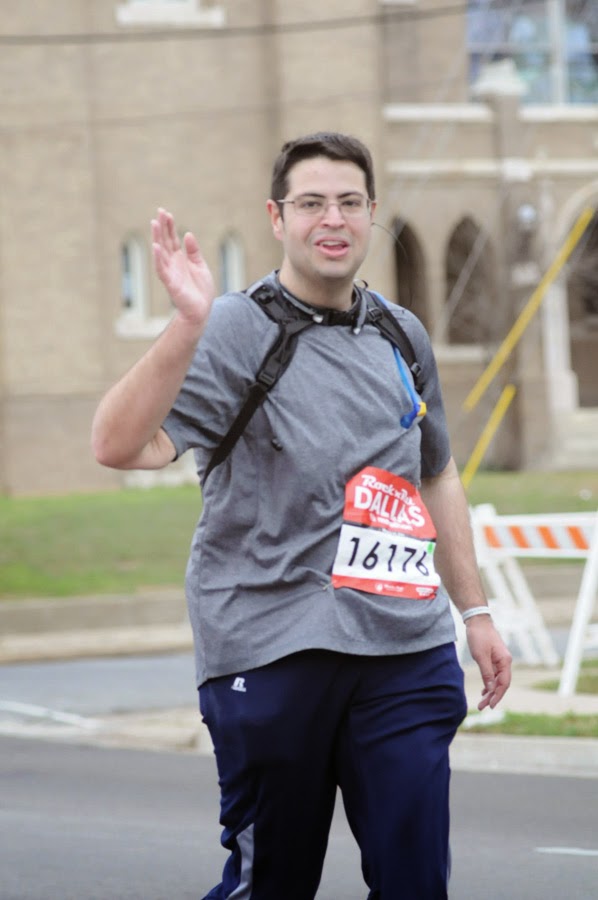
Back in December, a walking warrior friend convinced a bunch of us to do the Rock 'n Roll half marathon with her.  I haven't mentioned yet except for briefly in this post about the walking / running I do. Somehow, and I'm not sure how or why, I started joining a group of awesome sleevers who like to get up way too early on weekends to walk around a local nature preserve.  And by early, I mean 6:15am, which means waking up no later than 5:30.  Yeah, again, not sure what motivated me to start doing this, though soon I figured out that finishing an extended workout by 8:00 with your whole day still left was nice.

I started walking with them in the Summer, where I struggled to keep up, and finishing a lap of just over two miles left me winded and spent.  I remember being shocked when they said they were going for a second lap!  I had never walked more than two miles intentionally except for one time; a 5K I completed with a friend that left me exhausted and took 90 minutes to finish.  But I grudgingly did the 2nd lap with them, and as Summer turned to Fall, and the temperature and pounds began to drop, we started walking more and more, faster and faster.  By October, six to seven miles twice a weekend was common.  One day in November, we did 10.  We would be engrossed in conversation and barely noticed that we were exercising.  It was (and still is) awesome.  Not to mention the coffee or breakfast that would inevitably follow.

panorama shot of the sunrise at Arbor Hills Nature Preserve, our normal walking haven

By December, we'd hit our stride, figuratively and literally.  Instead of spending the time off sleeping in and eating delicious Christmas goodies, we were out there most mornings plugging away.  So when this friend brought up the half marathon, I was hesitant at first, but warmed up to the idea quickly.  It was only a few miles more than the most we'd already gone, after all.  And it fell only two weeks after my surgiversary, so it was very symbolic to me, representing all that I had accomplished for my health over the last year.  

Around this same time, I went from walking to doing a good bit of running.  In September, I was able to run for one minute before I pooped out.  It took a while to build to two, then three, then a half mile, then eventually two straight miles.  By the 2nd week of January, two miles turned into five.  By the end of February, I completed a 10 mile run.  My cardiovascular function was pretty great.  I wasn't that fast, but I was steady.    

But that run took a toll on my body, or rather not allowing myself to recover before running again did.  I ran on the treadmill two days later, and I just didn't feel right.  I was tired and my muscles were tight. By the evening, my left Achilles tendon started to ache.  It got worse over the next two days and started to really hurt.  I couldn't take a normal step without grimacing.  I looked up causes of Achilles tendonosis, and I had made every mistake on the list.  Ramping up mileage too quickly?  Check.  Too many hills? Big check.  Arbor Hills has that name for a reason.  Was I a male between the ages of 30-40? Not much I can do about that, but yes, check.  

I was pretty bummed.  I couldn't join my friends to walk that weekend, and more than that, everything I had read said this injury was hard to recover from due to lack of bloodflow in that area.  Some people were out weeks, even months.  Of course the key to healing was RICE - rest, ice, compression, elevation, with the first two being most important.  But how could I rest with a half marathon coming up in just a few weeks?  The truth was, I didn't have a choice.  Not much chance of completing a half marathon if I could barely walk.  It got a little better throughout the week, but even after several days, it still hurt a lot.  I stayed off of it as much as possible, iced it frequently, did some stretching exercises, all of which helped, but didn't last for very long.  My saving grace, if you wanna call it that, was getting a stomach virus that put me in bed for 24hrs.  My foot healed more in that day than it had in a week. When I recovered from that brief illness, I found that I could take a normal step.  It still hurt, but I could follow through completely.  

Side note: I have very flat feet.  I run in Brooks Beast shoes, designed for heavier runners with flat feet to help with over-pronation.  I thought with these shoes, I no longer needed my custom orthopedic inserts.  I was wrong.  I added them back into the Beasts, which changed the way my foot landed for the better.  I also got two ankle braces to protect both Achilles tendons, and a knee brace for my right knee which was bothering me a little.  By the time race day came this past Sunday, I felt like the 6 million dollar man wearing all of my protective gear.   

starting line

I really wanted to be at 100% on the day of the half marathon.  I wasn't.  I wasn't comfortable taking as long a stride as I had before getting hurt, so I wasn't as fast (and I wasn't very fast before).  Also, because of the injury, it had been four weeks since I had done a run over 5 miles in length.  From everything I read, this isn't a huge deal for experienced runners who have trained for years, but for newbies, conditioning deteriorates more rapidly with several weeks off.  

Apparently there are a lot of crazy people in Big D


This race was the largest attended one I have participated in.  There were 16 corrals, ordered by speed so that the rabbits don't overrun the turtles.  As a turtle in corral #14, we were released nearly 25 minutes after the official race start, but our chip times would still be accurate.  Finally our turn came, and I felt pretty good at first.  I had a decent 5mph pace going; foot and knee felt good.  Still felt pretty good at the 10k mark, but I was starting to tire out.  Most of the first several miles were uphill, and my pace was going downhill fast.    

so true

Before getting hurt, I thought I might finish the race in under three hours.  That was my goal.  I knew that wasn't going to happen when I hit a wall between miles eight and nine.  I really wished I was done. Miles 10-13, I was running about as fast as most people were walking.

But I finished.  And I never 


stopped


 running.  


finisher's bling

I thought I would be emotional crossing the finish line.  Before the race, I envisioned finishing the race, arms in the air in cheesy yet epic Rocky fashion.  Most of my ending iPod playlist are from those films, which always inspire me.  In my runs before, I sped up when these tracks came on, but in this race, I think they allowed me to just keep going.  I was physically and mentally spent.  There was no arm waving at the end, just a feeling of relief that I could finally stop running, even knowing that when I did, I would be so sore.   

Three days later, I'm still sore, though not as.  It seems a surreal experience, one that I'm still not sure I believe I did, or that I could do.  When I started my weight loss journey, this was never on my bucket list to accomplish.  A year ago, I had no dream of becoming a runner, and that's still the case, though I guess it's hard not to claim to be one now.   I have no desire right now to do another race of this distance, or anything longer.  Honestly, the last four miles were no longer fun for me.  

                               The idea that I never have to do another one if I don't wanna :)

But no one can take away from me that I did this one, and did it without stopping.  I was upset that I wasn't in perfect shape (a relative term LOL) to do this race, but the fact that I finished it in less than great condition makes this even sweeter. It's nice to know that we can accomplish great things even when we aren't feeling the greatest ourselves.  

Because that's life.  

PS: It was pretty sweet going into work Monday morning, barely able to move, and seeing this in front of my computer monitor.  #awesomecoworkers


Friday, March 7, 2014

Surgiversary

One year ago today, my life changed.  I underwent gastric sleeve surgery on March 7th, 2013.   In my mind, having the surgery was a last resort, yet despite meeting people who had gone through it and seeing their successes, I never really envisioned my own.  I figured this would be another failed attempt, or that somehow, someway, I'd "beat" the surgery.  So far, thank God, I haven't.

My doctor has never really set a goal weight for me, but rather has asked me what my goal is.  I am grateful for this.  After all, it's not his goal that I'm working towards achieving - it's mine, whatever that may be.   Too many WLS doctors prescribe their own often very lofty weight loss goals to their patients, and the cynical side of me feels they do this to pad their own numbers.  My doctor did his job well - I never had any complications during or after surgery.  He gave me this great tool, but ultimately my weight loss is not up to him, it's on me.  The successes or failures are on my shoulders, not his.

When he asked me prior to surgery what my goal was, I said 220lbs.  At 360lbs, that number seemed so far fetched, so utterly unattainable, something I hadn't seen in over 20yrs when I was barely an adolescent.  Today, I am below my "goal".  But I'm not, because my goal has changed and constantly does.  I'm sure when I reach my new goal, I'll have a different one in mind.  This isn't a bad thing - I should always want to better myself - but I think it's something to keep in check.  At some point, I have to be happy with myself in the present, giving credit to how far I've come.  I'm getting better about that, but it can be hard.  To that end, in the spirit of giving myself credit, I want to thank and praise this guy.


I've heard WLS patients beat themselves up for letting themselves get as big as they were, and for missing so many things in their life because of their weight.  I'm not immune to that.  But the past is past, and rather than say what I might or could have done, I'm looking at what I did do.  This guy realized there was a problem, and that his way wasn't working.  Instead of giving up and living the comfortable life he had dug for himself (and he easily could have), he decided he wanted more.  He went from not knowing what a gastric sleeve was to having the procedure done in 5 weeks time.  He refused to imagine what could go wrong, or what it would be like to not have food as a source of comfort.

My life today is something I never could have imagined.  So much has changed in the last year, from priorities, to meeting amazing new friends, to wanting to run in a half marathon later this month.  Yet, I'm still the same guy I was before.  At least, I hope I am.  Yes, I look, and more importantly feel better, but I hope I don't treat people any differently.  The guy above was a good guy.  He allowed himself the chance to get more out of life.  Thanks for paving the way for this guy!


Wednesday, February 26, 2014

The Scale - Friend or Foe?

The main thing that prospective WLS (weight loss surgery) candidates ask is if we have any regrets with our decision to have WLS.  For most, the answer is a resounding "no", and almost everyone says they wish they had not waited so long to have the surgery.  This is now my answer too, but it took a little longer for me to come around.  I always try to tell the positives and negatives to people thinking about surgery.   For me, the negative, other than the considerable pain and preparation involved, was coming to terms with my decision the first few months after surgery.  Here I was, still fat, and unable to eat hardly anything.  Granted, this is what I signed up for.  Mentally I knew that - but emotionally, it took its toll.  

I was moody, though I think I hid it pretty well.  At least, I hope I didn't let it change the way I interacted with my friends or clients.  It certainly wasn't their fault.  But anyway, the one thing that I did have in my favor was that for once in my life, the scale was moving in the right direction, and not reversing.  Six weeks after surgery, I passed the lowest weight I had ever gotten to...

*this seriously just arrived at my work - CiCi's is promoting their kids' programs and brought in free 
 goodies - further proof that food addiction is hardest to overcome, hands down*


..."on my own", and the weight kept falling off each week thereafter.  Sometimes I'd lose 1-2lbs in a week, sometimes I'd stall and lose nothing, followed by a 3-5lb loss the next week.  The consistency was good, and I was happy with my progress, but each week I found myself more and more nervous to step on the damn thing.  What if this was the week that I stopped losing, or God forbid started to gain?  I wasn't sure how I would handle it.  Which leads me to the point of this post.

Friday's are my "official" weigh-in day - the day where I record the number.  I used to be very good about only weighing only once a week, and still profess that this is the best gauge of accuracy, not to mention the roller coaster ups and downs on the scale throughout the week is enough to drive one insane.  I've had many weeks where I didn't think I'd pull a good number, and was pleasantly surprised.  Sometimes the reverse happened, but it usually was still ok, just not what I had hoped for.  

So, against my better judgement, I hopped on the scale today.  Factoring in a 12 mile walk / run on Saturday and eight mile (thank you Eminem) walk on Sunday, I expected a good number.  I actually had a figure in mind.  Can you guess where this is headed?  

+3lbs.  

WTF?

It was one of those where I actually stepped on again, like the scale was going to magically adjust or say "just kidding" with a tongue sticking out of it's evil digital readout.  

I know in my head I haven't actually put on three pounds of fat.  My BMR (basal metabolic rate) is about 2100 calories per day - meaning that I have to consume that amount and do absolutely nothing to sustain that weight.  In order to put on three pounds in five days, I would be consuming 2000 calories per day over my BMR, so 4100 calories each of the last five days, assuming I didn't move a muscle.  

That didn't happen.  I'm not great about recording my intake, but I know that did not happen.  It doesn't even factor in the exercise over that time span, which was considerable.  So I know that number is not actually fat gain, and will probably go away in a day or two. 

So why does it still bother me so much?  

Whenever someone in my local or online support group talks about a weight gain, I reassure them that it's probably water weight or muscle gain, something the average scale can't account for.  And it's not like I'm blowing smoke; I actually believe the encouragement I'm giving.  

So why do I not allow myself the same courtesy?  Why don't I believe my own advice?  

Everyone who's been on the diet roller coaster knows the feeling of putting your all into it, not getting that immediate gratification, and quitting.  I've been there.  

I'm not quitting.  Fortunately, that isn't even an option anymore the way it was before.  I hated that at first, but now I've come to love it, and am worried I rely too much on my restriction vs putting the right foods into my body.  I can definitely consume more now than I could six months ago, and I worry that I won't have it in me to change some of the bad habits I've gotten into if and when the scale does start trending the opposite direction.    

This is where my irrational fear of putting three pounds on in five days comes from.  I'm doing some things very well, but I can improve on others.  Time to refocus.

Prior to surgery, I wouldn't have cared if I had put on 3lbs.  In the scheme of being nearly 200lbs overweight, who cares about three more?  In some ways, life was easier before surgery.  

But certainly not better.